Why it matters
- As of 17 November 2026, OpenAI documents ChatGPT Search as a multi-stage process that can rewrite prompts, query providers, review results, and issue follow-up searches.[1]
- OpenAI confirms third-party search-provider partnerships and partner-supplied information, but it does not publish a complete provider-by-query map.[1]
- Bing has a historically documented ChatGPT integration, while reported Google-result tests do not confirm a current Google–OpenAI provider agreement.[6]
- OAI-SearchBot controls eligibility for ChatGPT Search, GPTBot concerns potential training use, and ChatGPT-User handles user-triggered page visits.[2][11]
- OpenAI publishes no exact ranking formula or citation-selection rule, so allowing a crawler can make a page eligible without guaranteeing that ChatGPT will cite it.[2][11]
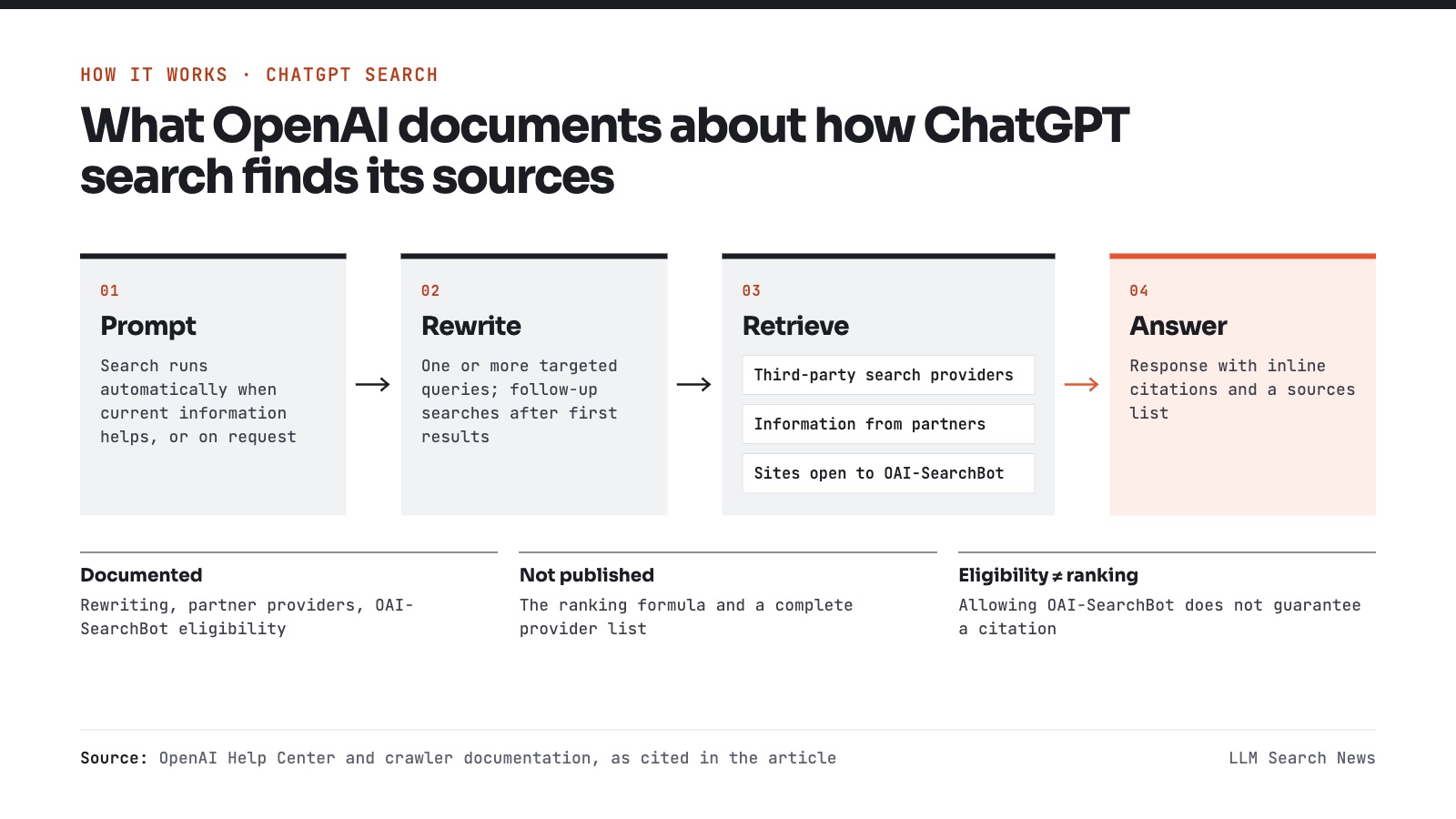
As of 17 November 2026, OpenAI documents ChatGPT Search as a multi-stage process: ChatGPT may decide that a question needs current information, rewrite it into one or more targeted queries, send those queries to search providers, review the results, and use them to generate an answer with source links.[1] OpenAI does not publish the exact ranking formula, provider-routing map, or rule that determines which retrieved page becomes a citation.[1]
What happened?
OpenAI’s current documentation describes ChatGPT Search as a search-and-generation system rather than a single lookup. ChatGPT can turn a user’s request into one or more search queries, retrieve relevant results, and use those results to produce an answer with links to sources.[1][2]
The documented process has several visible stages:
- ChatGPT determines that web search could improve the answer.
- It rewrites the user’s request into one or more targeted queries.
- It sends those queries to search providers when required.
- It reviews the initial results.
- It may issue additional, more specific searches.
- It generates an answer that can contain inline citations and a Sources panel.[3]
OpenAI’s documentation gives an example in which a question can be rewritten into a targeted query such as “CCR8 immunotherapy drug development 2025.”[1] That example shows that ChatGPT Search may search for a reformulated information need rather than the user’s original wording.
OpenAI also says that memory can influence query rewriting when memory is enabled.[1] For local results, the service may use an approximate location derived from the user’s IP address; OpenAI says the IP address itself and ChatGPT account information are not shared with search providers for the search.[1]
The public description therefore supports a multi-pass retrieval model. It does not establish a fixed number of searches, a universal sequence, or a single search index used for every request.[4][2]
Why does it matter?
The distinction between the user’s prompt and ChatGPT’s rewritten queries explains why ordinary keyword matching is an incomplete model of visibility. A page may be relevant to the user’s topic but fail to appear if it does not match the narrower queries ChatGPT sends to providers or if it is not eligible for OpenAI’s search crawling.[1]
It also explains why a citation is not simply a ranking position copied from a conventional search-results page. OpenAI says ChatGPT Search uses multiple factors intended to help people find relevant and reliable information, but it does not disclose the individual signals, their weights, or a deterministic scoring formula.[1]
OpenAI’s interface exposes only part of the result-selection process. Users can select an inline citation to open its source, preview citations on desktop, and select Sources to view cited sources and other relevant links.[1] The Sources panel can therefore contain links beyond the sources directly attached to individual statements.[3]
For publishers, the practical implication is equally specific: allowing OpenAI’s search crawler makes a site eligible for ChatGPT Search, but it does not guarantee a citation, a particular position, or inclusion for every relevant query.[1]
What do we know about search providers?
OpenAI says ChatGPT Search sometimes partners with other search providers.[1] When it does, ChatGPT typically rewrites the prompt into targeted queries and sends them to those providers.[1]
The current documentation does not identify the provider used for every query, disclose an exclusive provider, or publish a complete routing table. OpenAI’s launch material separately says ChatGPT Search can use third-party search providers and information supplied directly by partners.[5][1]
That distinction matters because partner-supplied information should not automatically be described as an ordinary search-engine result.[1] The public documentation confirms multiple possible information channels but does not describe how those channels are merged before the final answer is produced.[6]
Is ChatGPT Search powered by Bing?
Microsoft announced in May 2023 that Bing was being brought to ChatGPT as the default search experience for that product-era integration.[7] That announcement documented a Bing integration, but it does not by itself establish that every ChatGPT Search request in November 2026 uses Bing or that Bing is the exclusive provider.[8]
OpenAI’s current Help Center documentation describes partnerships with search providers without publishing a complete current provider list.[1] The defensible conclusion is that Bing has a historically documented relationship with ChatGPT, while the provider used for a particular current query is not publicly specified in the reviewed documentation.[9]
Does ChatGPT Search use Google?
Reported tests have suggested that some ChatGPT responses may reflect Google-indexed results.[6] Those tests do not establish a Google–OpenAI partnership, a fixed Google fallback rule, or universal Google routing.[10][6]
Google should therefore be described as test-based reporting, not as a confirmed OpenAI disclosure.[9][11] OpenAI’s own current documentation confirms partner-based search in general but does not identify Google as the provider for ordinary ChatGPT Search requests.
How does query rewriting work?
Query rewriting converts a conversational request into one or more targeted searches. OpenAI says ChatGPT Search typically rewrites a query before sending it to search providers and may use follow-up searches after reviewing initial results.[1]
A single user request can therefore produce several related information needs. For example, a question about a medical development could be rewritten into a query containing a specific molecule, treatment area, and year rather than sent verbatim to a provider.[1]
OpenAI does not publish the full rewriting algorithm.[1][12] The reviewed documentation does not specify how ChatGPT chooses terms, how many rewritten queries it creates, how it decides that a follow-up is necessary, or how it combines results from separate searches.
Memory can also affect rewriting when enabled.[1] OpenAI presents this as part of the information shared with search providers, alongside approximate location for some local-search requests.[1]
These details mean that prompt wording, context, freshness, and location can affect retrieval. The public material does not support a stronger claim about the relative importance of any one factor.[13][11]
What does OAI-SearchBot do?
OAI-SearchBot is OpenAI’s crawler for surfacing websites in ChatGPT Search results.[11][2] OpenAI says sites that opt out of OAI-SearchBot will not be shown in ChatGPT Search answers, although they may still appear as navigational links.[2]
OpenAI recommends allowing OAI-SearchBot in robots.txt and permitting requests from its published IP ranges when a publisher wants its pages to be eligible for search results.[2] OpenAI says changes to crawler access can take approximately 24 hours to affect its systems.[2]
OAI-SearchBot controls search eligibility, not ranking. Allowing it does not guarantee that a page will be retrieved, cited, or placed in a particular part of an answer.[2]
A publisher can use a robots.txt rule such as:
User-agent: OAI-SearchBot
Allow: /
The rule expresses permission for OpenAI’s search crawler, but the final result still depends on ChatGPT’s retrieval and answer-generation processes.[9]
How is OAI-SearchBot different from GPTBot and ChatGPT-User?
OpenAI describes the three user agents as serving different purposes.[2]
| User agent | OpenAI’s documented role | What the setting controls |
|---|---|---|
| OAI-SearchBot | Crawls sites so they can surface in ChatGPT Search results.[2][11] | Search eligibility. |
| GPTBot | Crawls content that may be used to train OpenAI’s foundation models.[2] | A training-use signal. |
| ChatGPT-User | Visits a page when a user asks ChatGPT or a Custom GPT to do so.[2] | User-triggered page access, not automatic Search crawling. |
OpenAI says the OAI-SearchBot and GPTBot settings are independent.[2] A publisher can allow OAI-SearchBot for search eligibility while disallowing GPTBot to signal that crawled content should not be used for training.[2]
ChatGPT-User is different because its requests are initiated by a user.[2] OpenAI says ChatGPT-User is not used for automatic web crawling or to determine whether content may appear in Search, and that robots.txt rules may not apply to those user-triggered requests.[2]
Publishers should therefore use OAI-SearchBot rules to manage automatic ChatGPT Search crawling rather than treating ChatGPT-User as the search crawler.[2]
How are citations displayed?
Search-enabled responses may include inline citations that open the cited source.[1] On desktop, users can preview a citation by pointing to it, and the Sources control can show cited sources and other relevant links.[1]
This interface provides provenance for readers, but it does not expose the internal source-selection algorithm.[4] OpenAI does not document a public rule that maps each retrieved result to a particular sentence or determines how many sources an answer must display.[4]
OpenAI also cautions that search results and citations can be incomplete, outdated, or incorrect.[1] It recommends opening the source, checking its date, and preferring authoritative sources when accuracy matters.[1]
A citation should therefore be treated as a verifiable link to supporting material, not as proof that the source was the highest-ranked result or that every part of a generated answer is fully supported.[3]
What is confirmed, and what is not?
| Question | Public status as of 17 November 2026 |
|---|---|
| Can ChatGPT rewrite a user’s request into targeted searches? | Confirmed. OpenAI documents query rewriting and searches sent to providers.[1] |
| Can ChatGPT issue follow-up searches? | Confirmed in OpenAI’s description. The documented process includes additional searches after reviewing initial results.[1] |
| Does ChatGPT Search use third-party search providers? | Confirmed. OpenAI says it sometimes partners with other providers.[1] |
| Is Bing historically integrated with ChatGPT? | Confirmed for the 2023 product-era announcement. Microsoft described Bing as the default search experience in that integration.[7] |
| Is Bing the only provider used by current ChatGPT Search? | Not confirmed. OpenAI does not publish an exclusive-provider statement in the reviewed documentation.[9] |
| Does ChatGPT Search use Google? | Suggested by reported tests, not confirmed by OpenAI.[9] |
| Is OAI-SearchBot used for ChatGPT Search? | Confirmed. OpenAI says it surfaces websites in ChatGPT search results.[2] |
| Does allowing OAI-SearchBot guarantee a citation? | No. OpenAI describes eligibility, not guaranteed placement or citation.[1] |
| Does GPTBot control ChatGPT Search visibility? | No. OpenAI describes GPTBot as a training-related crawler and separates it from OAI-SearchBot.[11] |
| Is the exact ranking formula public? | No. OpenAI describes multiple relevance and reliability factors without publishing weights or a formula.[12] |
| Does the Sources panel contain only inline citations? | Not necessarily. OpenAI says it can show cited sources and other relevant links.[1] |
Background: why retrieval and citation are different technical problems
Retrieval-augmented generation research separates the documents retrieved for a model from the model’s generated text. The RAG framework combines a generator’s internal knowledge with retrieved documents and conditions generation on those documents.[4]
That architecture does not, by itself, solve provenance. Research has treated citation support and citation precision as separate evaluation questions: whether claims are supported and whether cited material actually supports the associated statement.[3]
This distinction is useful when interpreting ChatGPT Search. Retrieval asks which documents enter the process; citation attribution asks which sources are attached to the answer; visibility research asks how stable those sources are across repeated prompts and time.[14] Academic systems and benchmarks help explain these problems, but they do not disclose OpenAI’s private Search ranking rules.[2]
A dated timeline of ChatGPT Search source selection
| Date | Development | What it establishes |
|---|---|---|
| 7 February 2023 | Microsoft announced a new Bing and Edge experience with AI-powered search and conversational answers.[12] | Bing and Microsoft were developing an AI-search relationship before ChatGPT Search launched. |
| 23 May 2023 | Microsoft said Bing was being brought to ChatGPT as the default search experience for the then-current plugin rollout.[7] | Bing was publicly documented as a ChatGPT search integration at that time. |
| 31 October 2024 | OpenAI announced ChatGPT Search with links to relevant web sources and a Sources interface.[15] | OpenAI publicly introduced the search-and-citation product model. |
| 2025 | Third-party reports described tests suggesting that some ChatGPT responses reflected Google results.[6] | Google-result use was reported experimentally, not confirmed as a provider agreement. |
| 31 October 2026 | OpenAI’s crawler documentation described independent controls for OAI-SearchBot, GPTBot, and ChatGPT-User.[2] | Search eligibility, training-related crawling, and user-triggered fetching were formally separated. |
| 17 November 2026 | OpenAI’s Help Center documented query rewriting, provider partnerships, citations, and the Sources panel.[1] | OpenAI’s current public account is a multi-pass process with undisclosed provider routing and ranking details. |
What should publishers do?
Publishers that want pages to be eligible for ChatGPT Search should review their robots.txt rules and allow OAI-SearchBot where appropriate.[11] They should also permit requests from OpenAI’s published IP ranges, as OpenAI recommends.[2]
Publishers should make a separate decision about GPTBot.[11] Blocking GPTBot signals that content should not be used for training, while allowing OAI-SearchBot preserves search eligibility under OpenAI’s documented controls.[2]
A publisher should not use ChatGPT-User as a proxy for Search visibility.[2] OpenAI describes it as a user-triggered page fetcher rather than an automatic search crawler.[11]
For measurement, publishers can inspect referral traffic and citation appearances, but those observations should not be treated as a complete view of retrieval. OpenAI’s public documentation does not reveal all candidate results, provider routing, ranking weights, or uncited searches.[12]
The strongest defensible workflow is therefore:
- Check whether OAI-SearchBot is allowed.
- Keep GPTBot policy separate from Search policy.
- Avoid describing Bing or Google as the universal current provider without direct confirmation.
- Open citations to verify the source and its publication date.
- Treat citation frequency as an observed outcome, not a disclosed ranking score.
- Recheck OpenAI’s crawler and Search documentation because the product and policies can change.
What is not confirmed?
OpenAI has not published the exact formula used to rank retrieved pages for ChatGPT Search.[2] Its public wording is limited to multiple factors intended to support relevance and reliability, without individual weights or guaranteed placement.[1]
OpenAI has also not published a provider-by-query map.[1] The documentation confirms third-party provider partnerships and partner-supplied information but does not state which provider handles a particular request or how results from different channels are merged.[6]
The reviewed documentation does not publish a general rule connecting a retrieved page to a specific inline citation.[1] It explains how users can open citations and view the Sources panel, not how the system selects or ranks each displayed source.[1]
Finally, reported Google-result tests should not be upgraded into a confirmed Google partnership.[9] The evidence supports a careful distinction between official documentation, historical integration announcements, and external behavioral observations.[8]
Frequently asked questions
How does ChatGPT Search choose sources?
ChatGPT may rewrite a request into targeted queries, send them to search providers, review the results, and issue follow-up searches before generating an answer.[1] OpenAI says ranking uses multiple factors intended to support relevance and reliability, but it does not publish the formula or factor weights.[1][12]
Does ChatGPT Search use Bing?
Microsoft publicly described Bing as ChatGPT’s default search experience in a 2023 integration announcement.[7] OpenAI’s current documentation confirms partnerships with search providers but does not establish that Bing is the exclusive provider for every ChatGPT Search request.[8]
Does ChatGPT Search use Google?
External tests have reported results that appeared to reflect Google-indexed pages.[2][14] Those tests do not confirm a Google–OpenAI agreement or a universal Google fallback, and OpenAI’s current documentation does not identify Google as the provider for each search.[6]
Sources
- 1Searching the web with ChatGPT | OpenAI Help Center help.openai.com
- 2Overview of OpenAI Crawlers developers.openai.com
- 3Evaluating Verifiability in Generative Search Engines - ACL Anthology aclanthology.org
- 4Retrieval-Augmented Generation for Knowledge-Intensive NLP Tasks proceedings.neurips.cc
- 5Introducing ChatGPT search | OpenAI openai.com
- 6ChatGPT is using Google Search, multiple tests suggest searchengineland.com
- 7Bing at Microsoft Build 2023: Continuing the Transformation of... blogs.bing.com
- 8Joint Statement from OpenAI and Microsoft | OpenAI openai.com
- 9ChatGPT Appears To Use Google Search As A Fallback searchenginejournal.com
- 10Brave Search API | Brave brave.com
- 11Publishers and Developers - FAQ | OpenAI Help Center help.openai.com
- 12Reinventing search with a new AI-powered Microsoft Bing and Edge, your copilot for the web - The Official Microsoft Blog blogs.microsoft.com
- 13Brave launches most powerful search API for AI to date | Brave brave.com
- 14Don't Measure Once: Measuring Visibility in AI Search (GEO) arxiv.org
- 15OpenAI adds new search function to ChatGPT | Reuters reuters.com